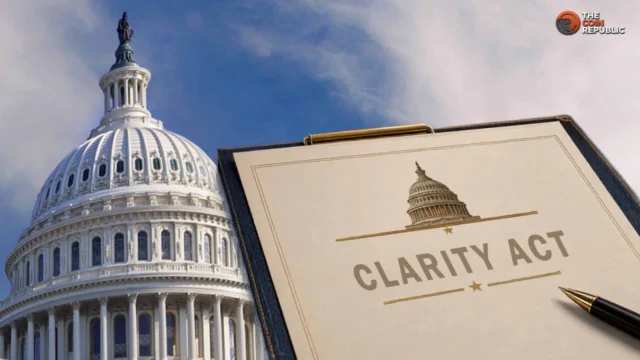


Key Insights
- Anthony Scaramucci stood up for Coinbase CEO Brian Armstrong, asserting that he was among the most dedicated champions of the CLARITY Act.
- The cryptocurrency legislation stumbled once more in the Senate due to conflicts over ethics regulations, stablecoin yield guidelines, and the necessary 60-vote threshold.
- Armstrong pushed back against media reports pointing the finger at him and Coinbase for the legislative hurdle, claiming the Wall Street Journal mischaracterized their involvement.
The CLARITY Act failed to clear a critical Senate procedural hurdle on September 15, 2026, quickly sparking a public controversy over who was at fault.
Coinbase CEO Brian Armstrong contested coverage that suggested he would be personally blamed for the outcome, while Anthony Scaramucci stepped in to defend the executive’s efforts.
Senators voted 49-50 against moving H.R. 3633 forward, falling short of the 60 votes needed. The proposed law sought to establish a federal regulatory structure for digital asset markets and define clear boundaries between the Securities and Exchange Commission and the Commodity Futures Trading Commission.
CLARITY Act Blame and Armstrong’s Response
Armstrong noted that The Wall Street Journal was preparing an article connecting him and Coinbase to the bill’s downfall.
He dismissed that perspective. Back in January, he had contested an earlier version over four specific concerns: smart contracts instead of banks and brokers.">decentralized finance regulations, tokenization rules, the extent of CFTC authority, and stablecoin rewards.
Armstrong mentioned that those points were resolved through subsequent negotiations, leading him to back the updated Senate draft.
“I’m proud to have done it, and would do it again, because it helped create a better bill,” he stated.
He accused the publication of echoing banking lobby talking points instead of acknowledging his long-term backing for federal crypto rules.
Stablecoin rewards emerged as one of the most contentious issues. Coinbase wanted to allow platforms to provide yield on idle stablecoin balances.
Banks considered these offerings too similar to traditional banking products, and this disagreement persisted throughout the broader discussions surrounding the CLARITY Act.
Scaramucci Defends Coinbase CEO
Anthony Scaramucci joined the conversation on September 20. “No one worked harder to advance the Clarity Act than @brian_armstrong,” he shared online.
Scaramucci characterized the result as “typical Washington nonsense” fueled by partisan friction. He stated that a compromise measure benefiting “all Americans” was blocked, calling the resulting blame game “total nonsense.”
This defense contrasted Armstrong’s history of advocacy with the political realities that ultimately halted the legislation.

Armstrong had spent years interacting with legislators and backing industry political campaigns. The final Senate proposal incorporated modifications addressing the issues he raised months prior.
Following the vote, Armstrong suggested the legislation was likely dead for the time being, pointing to the SEC and CFTC as alternative paths for creating clearer guidelines.
Seven Democratic senators indicated that bipartisan talks would persist, even though the immediate legislative route in Congress had shut down.
The setback of the CLARITY Act leaves the sector dependent on existing agency powers. Armstrong’s public denial of the blame narrative and Scaramucci’s defense of his involvement have shifted the post-vote dialogue toward procedural matters and accountability rather than the legislation’s original policy objectives.
This article is for informational purposes only and does not constitute legal, financial or investment advice.
FAQ
Why did the CLARITY Act fail?
The bill failed a Senate procedural vote 49-50, falling short of the required 60 votes amid disputes over stablecoin yield rules, ethics provisions, and partisan friction.
What was Brian Armstrong’s role?
Coinbase CEO Brian Armstrong was a prominent advocate for the bill after addressing early concerns regarding smart contracts instead of banks and brokers.">decentralized finance, tokenization, CFTC authority, and stablecoin rewards.
Who defended Brian Armstrong?
Anthony Scaramucci defended Armstrong publicly, stating that no one worked harder to advance the legislation and calling the blame game political nonsense.
What is next for crypto regulation?
With the legislation stalled in Congress, the industry will continue to rely on existing agency authority from regulators like the SEC and CFTC.




 Michael Gachihi Nderitu