Key Insights
- Binance invested $100 million in Circle by purchasing 1.24 million Class A shares at $80.84 each.
- Circle and Binance signed a new five-year agreement on September 17 to expand USDC adoption.
- Circle will pay Binance monthly incentive fees tied to USDC held through its wallet infrastructure.
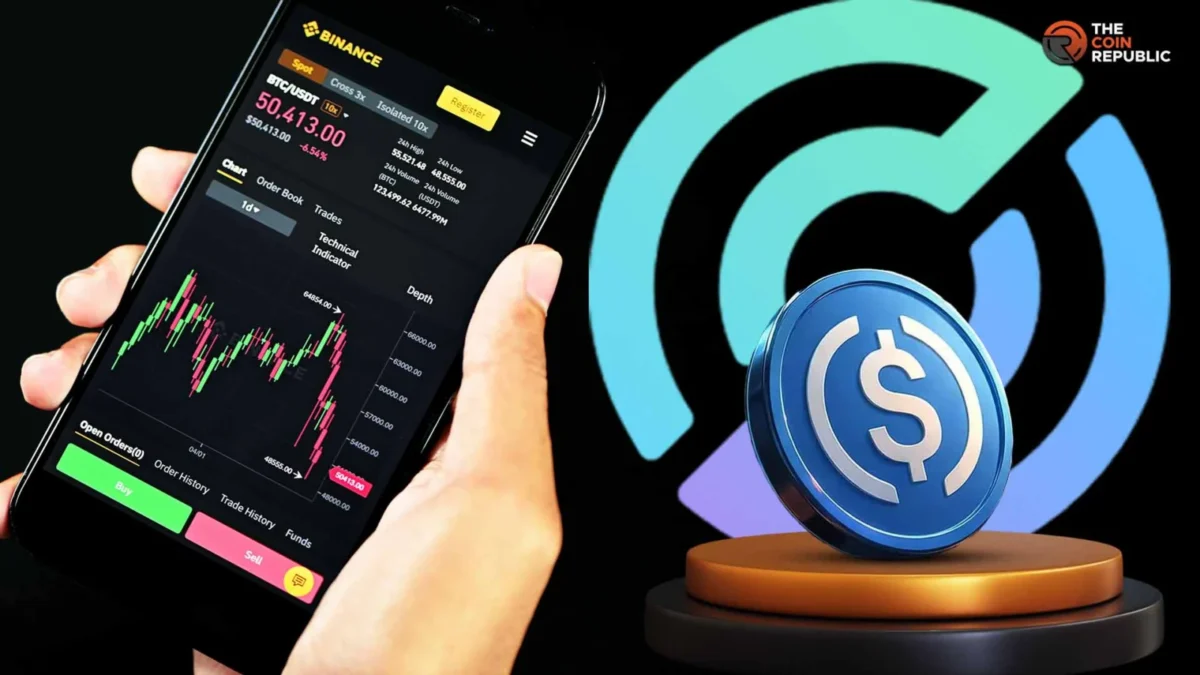
Recent developments in Binance news shifted toward stablecoins following the cryptocurrency exchange’s $100 million investment in Circle alongside a new five-year commercial pact aimed at broadening USDC distribution.
Circle disclosed that Binance acquired 1,237,011 Class A shares at a price of $80.84 per share through a private placement executed on Sept. 17. This transaction yielded $100 million in proceeds for Circle and closed concurrently with the new commercial agreements.
Both companies publicly unveiled this expanded alliance on Sept. 22. Under the terms, Binance will market and integrate USDC throughout its platform—with a particular focus on emerging markets—while Circle provides the foundational infrastructure powering the stablecoin’s utilization.
Binance and Circle Set Five-Year USDC Framework
The pact centers on volume a network can handle without fees or delays exploding.">scaling access to USDC via Binance, especially across emerging regions. Binance is set to champion the stablecoin and deepen its platform integration. Simultaneously, Circle will deliver the infrastructure services necessary to manage USDC balances and operations.
Jeremy Allaire, Chief Executive of Circle, noted that the partnership aims to widen digital dollar reach in emerging economies. He additionally highlighted savings options, investment offerings, and accessibility for businesses as well as individual users. However, the released details did not specify which exact countries fall under this geographic expansion.

Richard Teng, Binance co-CEO, characterized the investment and accord as a five-year collaborative effort alongside Circle. He also pointed to USDC, Circle’s Arc network, and cross-border value transfer systems. Notably, the $100 million equity purchase functions as a core component of this broader commercial alliance.
The firms had previously maintained a working relationship prior to formalizing this fresh contract. The updated agreement extends their partnership for another five years with a razor-sharp focus on widespread USDC availability, delineating distinct responsibilities for distribution and infrastructure services.
USDC Circulation Stands Below Tether’s USDT
This milestone unfolds as USDC and Tether’s USDT operate as prominent dollar-pegged stablecoins within the crypto ecosystem, both striving to maintain a stable 1:1 parity with the U.S. dollar.
Presently, USDT boasts a circulating supply totaling $183 billion. In contrast, USDC maintains a circulation of roughly $75 billion, leaving USDT ahead by an estimated $108 billion.

The two assets also employ divergent market strategies. USDT sees heavy utilization in international digital asset trading, whereas USDC places its emphasis on regulated markets, transparency, and payment solutions. Both stablecoins continuously compete across global cryptocurrency trading, payments, and alternate financial avenues.
Circle Expands USDC Role Through Arc Mainnet
The USDC partnership closely follows Circle’s rollout of the Arc Layer 1 public mainnet on September 16. According to reports from The Block, protocols such as Aave V4, Morpho, and Uniswap were operational from day one. Users pay gas fees on Arc utilizing USDC, directly connecting the stablecoin to underlying blockchain mechanics.
The public testnet for Arc debuted in October 2025, handling upwards of 700 million transactions in under a single year, per Circle. Meanwhile, the public mainnet features sub-second transaction finality alongside native compatibility with the ETH as its native asset.">Ethereum Virtual Machine.
This EVM compatibility enables pre-existing Solidity smart contracts to function seamlessly on Arc. Consequently, developers can leverage existing codebases when launching applications on the network. Furthermore, Circle designated USDC as the designated gas token for transactions executed on Arc.
Allaire characterized Arc as foundational infrastructure meant for onchain financial operations and ecosystems reliant on digital dollars. His statements linked the network directly to decentralized applications that demand continuous settlement solutions and institutional-grade architecture. Meanwhile, the Binance deal centers explicitly on expanding USDC access, promotion, and integration directly across the exchange.
Together, these parallel developments embed USDC firmly inside Circle’s proprietary blockchain infrastructure and Binance’s vast distribution network. Arc mandates USDC for gas payments, while Binance scales up USDC integration pursuant to their five-year pact.
This article is for informational purposes only and does not constitute financial or investment advice.
FAQ
How much did Binance invest in Circle?
Binance invested $100 million by acquiring 1.24 million Class A shares at $80.84 each.
What is the duration of the new Binance and Circle agreement?
The newly established commercial agreement lasts for five years.
What is the circulating supply of USDC compared to USDT?
USDC has a circulation of about $75 billion, whereas USDT leads with a circulating supply of $183 billion.
What token is used for gas fees on Circle’s Arc mainnet?
Users pay transaction gas fees on the Arc network using USDC.

 Arnold Kirimi
 Michael Gachihi Nderitu