
Key Insights:
- Bitcoin news shows over 71% of supply now sits in profit.
- BTC price recovered near $78,600 after a $77,603 intraday low.
- Bitcoin ETFs logged $31.07 million daily and $698.42 million weekly inflows.
Recent Bitcoin updates focus on a crucial profit threshold as more than 71% of the total BTC supply entered profitable territory. On Tuesday, the BTC price bounced back toward $78,600 following a dip to an intraday low of $77,603, remaining below the $82,000 mark achieved the previous week. According to Glassnode, long-term holder supply offers a better explanation for one-month realized volatility than market capitalization, open interest, funding rates, or overall trading activity.
The latest reports highlight that past movements surpassing this 71% threshold have generally coincided with shifts from bear to bull markets. Even so, a larger percentage of profitable coins can increase potential sell-side liquidity close to prior local highs. This indicator reflects market structure rather than guaranteeing a BTC price breakout.
Bitcoin News Shows How Holder Supply Drives Low Volatility
Glassnode ranked long-term holder supply as the primary variable explaining one-month realized volatility. Illiquid supply came next, followed by liveliness and absolute funding rates, while market capitalization placed much lower on the list.
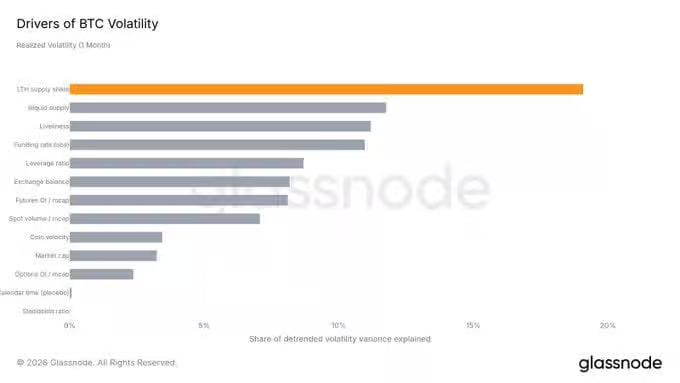
This insight shifts focus from total market size to coin ownership patterns. Long-term holder supply tracks BTC held by entities that rarely trade. When a higher volume of coins remains inactive, fewer units circulate through speculative trading channels, potentially dampening short-term price fluctuations during stable periods. This distribution profile helps explain the current volatility environment.
Glassnode categorizes holder groups based on the average acquisition date for an entity, using a 155-day threshold to separate older coins from newer, more actively traded holdings.
Profit Supply Nears 74.7% With Bitcoin Trading Near $78,000
Data from Bitfinex indicates that over 74% of the Bitcoin supply is currently in profit, compared to roughly 67% when BTC traded above $82,500 during the May consolidation phase. Additionally, the short-term holder cost basis declined to $68,400 over the summer.
Bitfinex places the historical average at 74.7%, noting that previous crosses above this level have signaled bear-to-bull transitions. Although profitable supply is not an independent bullish indicator, having more coins in profit at comparable price levels creates a deeper reservoir of potential sellers near past local highs, which may clarify why rallies approaching $82,000 tend to encounter profit-taking.
On Tuesday, Bitcoin briefly slipped beneath $78,000, hitting a daily low of $77,603 before staging a recovery. By late morning, the BTC price rebounded near $78,600, a price swing that leveraged position when margin no longer covers losses.">liquidated $79 million in Bitcoin positions and contributed to total crypto liquidations of $264 million, which included $187 million in long positions.
Readers should note that the price targets and market levels referenced in this piece rely on technical analysis and do not serve as guarantees of future outcomes. This content is published strictly for informational purposes and should not be construed as financial advice.
Due to the high volatility of the cryptocurrency market, individuals are advised to perform independent research or speak with a licensed financial expert before executing any investment choices.
Bitcoin News Tracks ETF Inflows and Inflation Data
Lookonchain documented $31.07 million in daily net inflows for Bitcoin ETFs, bringing seven-day inflows to $698.42 million. Bitfinex also pointed to sustained ETF interest and stablecoin expansion as key market supports.
According to Bitfinex, the total market capitalization of cryptocurrencies excluding Bitcoin, ETH as its native asset.">Ether, and stablecoins has grown by $51.2 billion since the beginning of September, surpassing mid-August levels. Current market coverage now monitors whether ETF inflows will maintain their momentum through the September 9 DAO controls and spends.">Treasury buyback. Meanwhile, the Bureau of Land Statistics scheduled the August PPI release for Thursday, followed by the August CPI report on Friday.
With the two-year DAO controls and spends.">Treasury yield staying above 4.34%, short-term interest rates remain a primary focus. August payrolls expanded by 162,000 jobs, outpacing the 53,000 consensus forecast, meaning an elevated inflation reading could strengthen the argument for tighter monetary policy.
Such developments could pressure risk assets and stall a continued BTC price rally, even in the presence of strong fund inflows. Bitfinex suggests that consistent buying amid these events would signal that investors view policy interest rates less as a strict limitation.
FAQ
- What percentage of Bitcoin supply is currently in profit?
Over 71% of the Bitcoin supply is sitting in profit, with specific figures nearing 74.7%. - What drives low Bitcoin volatility according to Glassnode?
Glassnode ranks long-term holder supply as the primary driver of one-month realized volatility, followed by illiquid supply, liveliness, and absolute funding rates. - What were the recent Bitcoin ETF inflow figures?
Lookonchain reported $31.07 million in daily Bitcoin ETF net inflows and $698.42 million in weekly inflows. - What factors are influencing the current BTC price trend?
Market movements are being impacted by profit-supply thresholds, ETF demand, DAO controls and spends.">Treasury yields, and upcoming macroeconomic inflation data like the PPI and CPI.