Key insights:
- स्टेबलकॉइन समाचार centers on U.S. Bank’s live cross-border USBDC payment pilot.
- The bank used Stellar to connect the payment to its internal infrastructure.
- The bank also plans separate dollar and euro स्टेबलकॉइन्स for launch in 2026 and 2027.
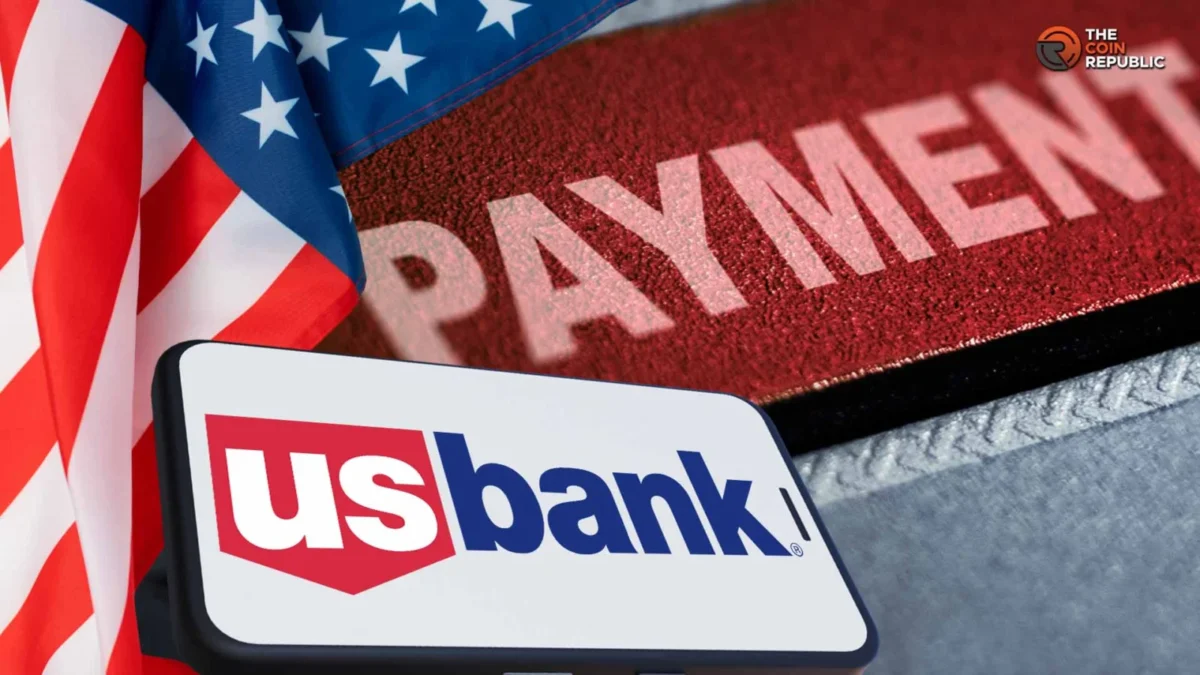
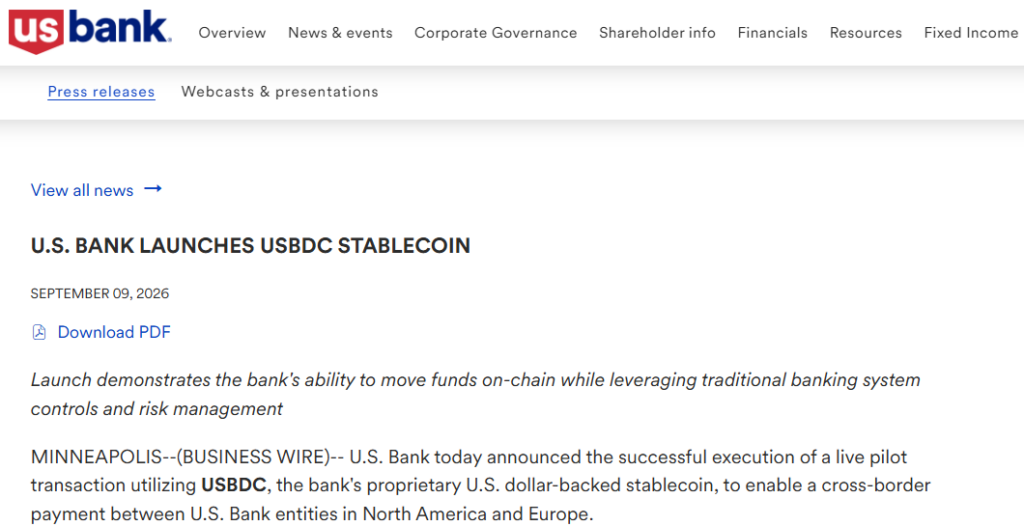
U.S. Bank has successfully finalized a live cross-border transaction utilizing its proprietary dollar-backed USBDC stablecoin. The transfer moved funds between U.S. Bank branches in North America and Europe, testing how USBDC payments function alongside existing operational and financial systems. The institution executed this transaction on the public Stellar blockchain.
Significantly, the trial linked blockchain-based settlement directly with the bank’s risk, compliance, operations, and finance infrastructure. This framework enabled U.S. Bank to execute on-chain value transfers without disconnecting transactions from internal oversight protocols.
Stablecoin News: Core Controls for USBDC Payments
Additionally, the evaluation assessed vital capabilities needed to administer a bank-released digital token. Tested functions included minting, processing, and redeeming USBDC. During the test, U.S. Bank additionally trialed clawback and freezing mechanisms.
To power these processes, the institution relied on its internally built Digital Asset Platform, which delivers the technological foundation required to issue, manage, and send tokenized instruments. Furthermore, the platform bridges legacy banking frameworks with supported ब्लॉक.">वितरित लेज़र में समूहीकृत किया जाता है networks.
U.S. Bank also highlighted USBDC as among the initial bank-created स्टेबलकॉइन्स launched on a public blockchain network. Executives noted that this architecture can facilitate 24/7 transactions, including periods outside traditional banking hours.
Chief Executive Officer Gunjan Kedia stated that the trial examined enhanced money movement and faster global cash management. She additionally connected the transfer to the bank’s broader adoption of ब्लॉक.">वितरित लेज़र में समूहीकृत किया जाता है technology within its established operational framework.
Stellar Supports the Live Transaction
This transfer builds upon U.S. Bank’s existing partnership with the Stellar Development Foundation. Stellar provided the public ledger technology utilized to execute the cross-border payment between the lender’s regional divisions.
Following this trial, U.S. Bank is exploring several institutional use cases for the technology. Potential applications include collateral mobility, liquidity management, treasury operations across borders, and alternative settlement workflows.
Jamie Walker, head of डिजिटल संपत्तियां and money movement at U.S. Bank, characterized the pilot as a component of the firm’s broader digital asset strategy. He emphasized that the bank concentrates on practical client solutions while upholding strict security, safety, and reliability standards.
At the same time, USBDC transactions form part of a broader industry transition across major global financial institutions. Reuters reported that Wells Fargo, Citigroup, Bank of America, and Goldman Sachs have partnered on plans for a separate dollar stablecoin initiative.
The participating banks intend to establish a joint company in 2026 to oversee the project, with plans to roll out the dollar-पेग्ड asset during the first half of 2027.
This group first disclosed the project in October 2025 alongside ten participating lenders. The consortium also intends to release स्टेबलकॉइन्स tied to other Group of Seven currencies, prioritizing the euro.
Stablecoin News Draws Regulatory Scrutiny
Meanwhile, a separate coalition comprising 37 financial institutions has established an entity named Qivalis. According to Reuters, Qivalis aims to roll out a euro-backed stablecoin later in 2026.
Certain financial institutions participate in both initiatives. For example, Spanish lender BBVA belongs to both the Qivalis consortium and the dollar-focused banking group. Additionally, World Liberty Financial—the family-backed crypto venture of President Donald Trump—has released its own distinct stablecoin.
Concurrently, European Central Bank President Christine Lagarde voiced concerns regarding privately issued stablecoins. She cautioned that such digital assets could impact financial stability and monetary policy absent robust regulatory oversight.
She noted that unbacked cryptocurrency markets expanded from under €200 billion at the beginning of 2020 to approximately €2.7 trillion by 2025.
Lagarde attributed this growth to speculative investor demand and severe price swings. She argued that these traits render unbacked assets unreliable for payments and expose market participants to financial vulnerability.
अक्सर पूछे जाने वाले प्रश्न
- What blockchain did U.S. Bank use for the USBDC pilot?
U.S. Bank conducted the live transaction on the public Stellar blockchain. - When do major banks plan to launch their joint dollar stablecoin?
A group of major banks plans to form a managing company in 2026 and issue the stablecoin in the first half of 2027. - What is Qivalis?
Qivalis is a company formed by 37 financial institutions that plans to launch a euro-backed stablecoin in 2026. - What concerns did Christine Lagarde raise about crypto?
She warned that unbacked crypto assets could impact financial stability and monetary policy due to price volatility and lack of regulation.