

Key Insights:
- Scrutiny of crypto scams intensified following an $8.5 million exploit targeting Term Labs.
- Malicious actors drained ETH as its native asset.">Ethereum and USDC from impacted Term vaults.
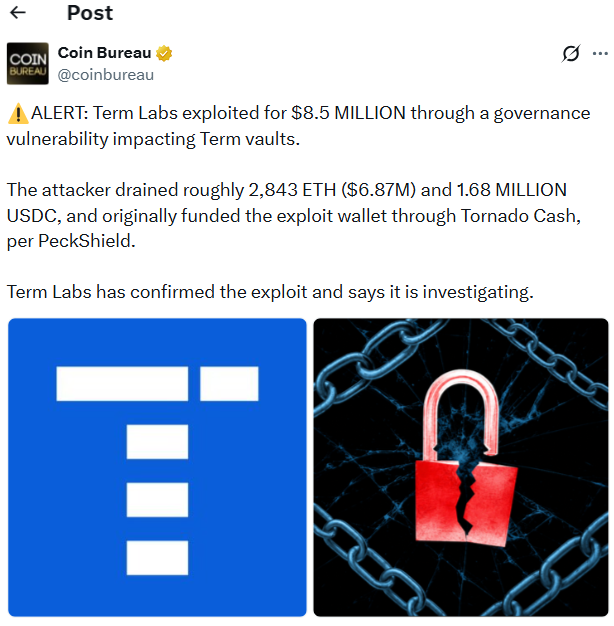
Term Labs issued a statement on X confirming that a governance exploit impacted its vaults on August 23, 2026. The security breach heightened awareness of crypto scams after analytics firms monitored roughly $8.5 million leaving the protocol. The attack compromised ETH as its native asset.">Ethereum holdings and USDC stored within the Term-linked vault framework.
The event drew attention because governance vulnerabilities can compromise pooled funds without breaching the underlying ETH as its native asset.">Ethereum network.
Term Finance had previously cautioned users that vault smart contracts might harbor weaknesses capable of triggering financial losses. Legal disclaimers from the project noted that Term Vaults depend on external smart contracts instead of banks and brokers.">decentralized finance protocols and Yearn v3 contracts.
Crypto Scams Focus Shifts to Term Labs Governance Exploit
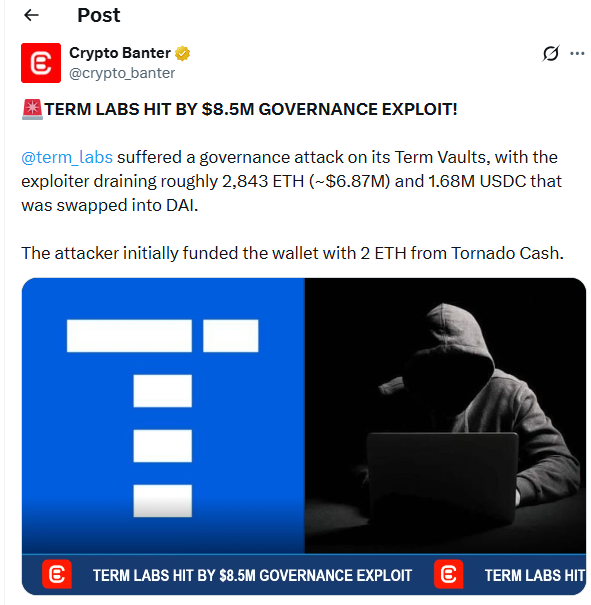
According to PeckShield, the perpetrator extracted roughly 2,843 ETH, estimated at $6.87 million, during its initial assessment. The blockchain monitoring firm also detected 1.68 million USDC moving out of the compromised vaults before being swapped into approximately 1.6 million DAI.
PeckShield traced the hacker’s starting capital back to two ETH sourced via Tornado Cash. This transaction path did not reveal the culprit’s identity or indicate broader money laundering practices; it merely highlighted the stated origin of the funds utilized prior to the attack.
Term Labs verified the governance breach via its official X channel. Representatives stated that the incident targeted Term vaults and remains under review, though a technical postmortem had not been published when this report was compiled.
CertiK evaluated the governance attack separately, putting total losses around $8.5 million. Its tracking isolated the hacker’s wallet at 0xD5183d8BfC65a50863C62aF2538198A8288FFc13, which subsequently held 2,843 ETH alongside about 1.6 million DAI.
Crypto Scams Debate Centers on Vault Governance Risk
Official documentation outlines Term Finance as a non-custodial, fixed-rate lending protocol built on Ethereum. Its Term Repos utilize smart contracts to secure collateral for both lenders and borrowers, with isolated lockers designed to minimize risk compared to a single collective collateral pool.
Protocol guides further separated vault risk from the primary lending framework, explaining that repo collateral remains inside designated smart lockers while vault operations interface with external protocols.
Although this setup mitigated shared-pool vulnerabilities, it failed to eliminate contract or governance threats. The protocol’s terms of service explicitly warned participants that deposited capital could be partially or entirely lost.
The breach affected Term Vaults rather than the protocol’s fundamental repo mechanism. Legal disclosures specify that these vaults run on Yearn v3 infrastructure, warning that bugs, external protocol breakdowns, strategy faults, or vulnerabilities could cause financial damage.
This distinction is critical for observers monitoring crypto scams and security breaches. A governance exploit targets administrative privileges or authorization workflows rather than the Ethereum consensus mechanism. Term Labs has not yet revealed the specific governance vector, permission sequence, or contract path utilized.
A disclosure statement from Kraken characterizes Term Finance as an Ethereum-based, non-custodial lending platform developed by Terminal 0 Ltd., which operates as Term Labs. The document also noted that TERM governance management was slated for transition following the rollout of a Governor contract.
Because the document preceded the attack, it did not reference the August 23 exploit, though it offered background regarding the platform’s intended governance framework. Term Labs has not indicated whether the upcoming Governor architecture contributed to the incident.
Crypto Hack Leaves Ethereum and USDC Trail Under Review
Despite scarce technical details, the movement of funds provided investigators with concrete verification points. PeckShield observed ETH and USDC transfers, whereas CertiK identified ETH and DAI balances inside the perpetrator’s wallet, corroborating PeckShield’s findings regarding the post-extraction token swaps.
Available data showed no indication of a compromise within Ethereum or USDC systems. Instead, Term Labs classified the event as a governance incident impacting its vaults, keeping accountability tied to protocol administration rather than the underlying base networks or assets.
Term Finance had previously outlined potential cybersecurity hazards across its offerings, advising users that smart contract failures, governance disputes, security breaches, and third-party protocol issues could impact their funds. Those warnings did not specify the exact vulnerability exploited in this attack.
The upcoming progress report promised by Term Labs will serve as the next verifiable milestone. Depositors and traders await details concerning impacted vault identifiers, targeted contract addresses, recovery plans, and potential governance updates. A detailed postmortem is expected to determine whether any of the stolen capital can be retrieved.
FAQ
- What caused the Term Labs exploit? Term Labs confirmed a governance exploit affected its vaults on August 23, 2026.
- How much money was stolen in the attack? Security firms like PeckShield and CertiK tracked roughly $8.5 million in total outflows.
- Which assets were drained from the vaults? The attackers drained Ethereum assets and USDC, which was later swapped for DAI.
- Are the underlying Ethereum and USDC networks compromised? No, investigators found no evidence of a compromise in the underlying Ethereum or USDC infrastructure.