

Key Insights
- Bitcoin ETF inflows reached $998.95M Monday, the ninth-largest daily total since spot funds launched.
- Crypto ETFs entered focus as Bitcoin price tested the $83K-$86K holder supply zone.
- Bitcoin short liquidations reached $345M as price entered a dense liquidation range.
Trading near $86,000 on Tuesday, Bitcoin reached its highest level since January, bolstered by a clear spot-market signal from ETF inflows. According to CryptoQuant data, U.S.-listed spot Bitcoin ETFs brought in $998.95 million in net inflows on Monday, marking their highest daily total since Bitcoin hit its record high in October 2025. This surge drew renewed attention to crypto ETFs as the asset moved into the $83,000-$86,000 supply zone.
During the session, Bitcoin briefly touched $86,502 after climbing over 10% from the previous Sunday’s close. ETF demand was accompanied by $345 million in Bitcoin short liquidations, which spurred additional buy-side pressure as short positions were forced to close. This price action places Bitcoin squarely inside a heavy holder supply band ranging from $83,000 to $86,000.
Monday Ranks Ninth Among Daily Spot Bitcoin ETF Totals
Monday’s net additions marked the ninth-largest daily inflow since U.S. spot funds began trading in January 2024. It was also the highest daily figure recorded since October 6, 2025, when Bitcoin traded near $126,200. Furthermore, the three-day positive streak was the first observed in two weeks.
BlackRock’s IBIT led the pack with $381.37 million, followed by ARKB drawing $289.12 million and Fidelity’s FBTC securing $238.84 million. Together, these three funds accounted for the majority of the day’s aggregate total. Meanwhile, September’s cumulative flow hit $1.31 billion, declining from August’s $3.52 billion.

Trading volume across the Bitcoin ETF market surpassed $4.5 billion on Monday. While trading volume measures share turnover, net inflows track fresh capital moving in and out of the funds. Both metrics climbed as Bitcoin pushed through the mid-$80,000 price bracket.
Net flows for crypto ETFs illustrate share creations and redemptions, though they do not disclose the exact timing or execution venue of the underlying Bitcoin acquisitions. While ETF share creation helps facilitate underlying purchases, it does not map out every single intraday trade.
Overall, spot Bitcoin crypto ETFs still face a year-to-date deficit of roughly $450 million. A weekly snapshot from Glassnode also pegged net flows at a negative $300 million. Monday’s strong inflow enhances the daily outlook, though it does not completely reverse these broader trends.
Bitcoin ETF Inflows Meet a Dense $83K to $86K Supply Zone
Glassnode estimated that long-term investors accumulated a major share of 1.07 million BTC between $83,000 and $86,000, with the densest concentration sitting close to $85,000. These specific coins remained largely inactive throughout the 30-day observation window.
The influx of Bitcoin ETF capital arrives just as prices re-enter this estimated cost basis. Investors reaching their break-even point may choose to trim their exposure, though continuous spot demand has the potential to absorb the supply offered to the market.
Fund investors have reclaimed an essential price threshold, having previously traded below the $83,000–$86,000 band for 228 consecutive sessions. At the February low, the aggregate unrealized losses for these funds reached approximately $18 billion.
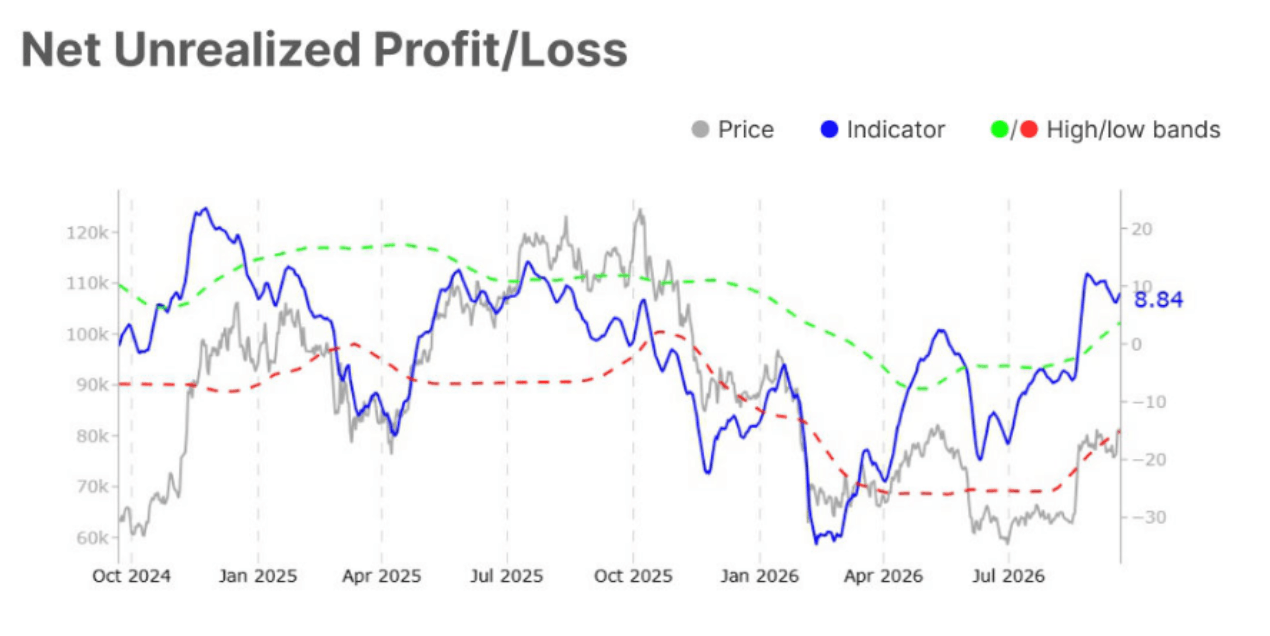
Glassnode notes that roughly two-thirds of the circulating Bitcoin supply is currently sitting in profit, with realized profit-taking positioned above normal historical ranges. These metrics point to a critical cost-basis level where market participants are likely to re-evaluate their exposure as prices put that sentiment to the test.
Bitcoin ETF Inflows and Short Covering Test the $86K Level
The rise in Bitcoin ETF inflows coincided with accelerated activity in the derivatives market. At least $345 million in Bitcoin short positions were unwound in a single day as prices climbed. This short covering generated extra buying momentum as bearish bets were closed out. Furthermore, futures open interest and funding rates both rose, highlighting elevated leverage during the rally.
Glassnode pointed out that modeled short-liquidation levels stretching from $82,000 to $86,000 expanded by 21% following the August 19 squeeze. A sustained breakout past $86,000 would push Bitcoin beyond a densely populated liquidation corridor, putting fresh spot demand to the test against heavy holder supply.
According to CoinRepublic’s BTC price analysis, $87,000 represents the next target to watch if Bitcoin manages to stay above $85,000, followed by $90,000 and $92,000 as subsequent resistance zones. Bitcoin ETF inflows, holder supply metrics, and leverage data remain critical barometers as BTC navigates these price tiers.
This article is for informational purposes only and does not constitute financial or investment advice. Cryptocurrency and derivatives trading involve substantial risk.
How much did Bitcoin ETFs bring in on Monday?
U.S.-listed spot Bitcoin ETFs recorded $998.95 million in net inflows on Monday, marking their largest daily total since October 2025.
Which ETFs led the daily inflows?
BlackRock’s IBIT led with $381.37 million, followed by ARKB with $289.12 million and Fidelity’s FBTC with $238.84 million.
What was the total value of Bitcoin short liquidations?
Bitcoin short liquidations reached $345 million as prices entered a dense liquidation range.
What is the key supply zone for Bitcoin currently?
Bitcoin is currently testing a dense holder supply zone between $83,000 and $86,000, with the largest concentration near $85,000.