

Key Insights
- The Bitcoin price outlook softened after BTC failed to clear the $81,300 resistance zone.
- Bitcoin futures positioning stayed high as spot values slipped beneath $80,000.
- Spot Bitcoin ETF inflows stretched out to a streak of seven straight trading sessions.
Bitcoin price projections turned more cautious after BTC could not maintain its position above $81,000. During the August 25 trading session, Bitcoin climbed to about $81,200 before sellers forced the asset back under the $80,000 mark.
This rejection happens while derivatives positioning remains high, raising the threat of increased volatility around nearby technical markers. Even so, seven successive days of spot Bitcoin ETF inflows continue to balance out the bearish technical setup.
Bitcoin Price Prediction Weakens Below $80,000
Figures from CoinMarketCap positioned Bitcoin near $79,172 during the August 26 session. The value of Bitcoin dropped around 1.9% across a 24-hour period, while its market capitalization stayed close to $1.59 trillion.
Historical tracking from CoinMarketCap put Bitcoin at $78,379 on August 25, following a price of $78,964 recorded the day prior.
The figures framed the rejection as part of a volatile recovery rather than an isolated decline. Bitcoin had traded around $69,266 on August 19 before pushing aggressively toward resistance.
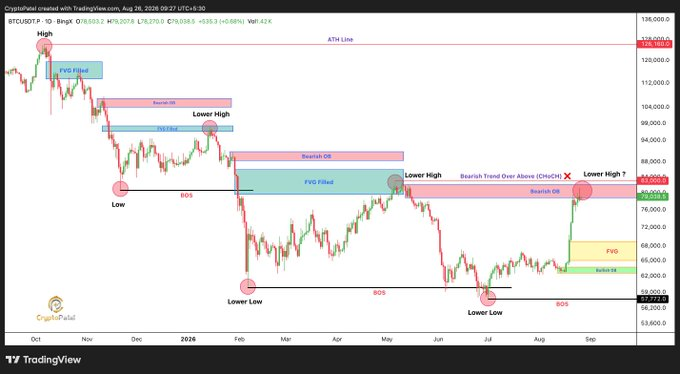
On X, analyst Crypto Patel noted that Bitcoin encountered selling pressure between $80,000 and $83,000. He observed that the daily candle formed an inverted hammer pattern following the rejection near $81,300.
Such a pattern can signal selling pressure when appearing after an upward move, though a single candle does not validate a complete reversal on its own.
Patel pointed to $83,000 as the structural invalidation point for his bearish outlook. He projected a fall toward $55,000 to $50,000 if Bitcoin fails to overcome resistance.
His target served as an analytical projection instead of a guaranteed market result. A decisive breakout above $83,000 would invalidate that downside scenario, he noted.
Bitcoin Price Prediction Meets Elevated Futures Exposure
Data from CryptoQuant revealed that Bitcoin futures open interest hovered around $55.8 billion on August 26. Over the preceding 24 hours, futures volume surpassed $98 billion.
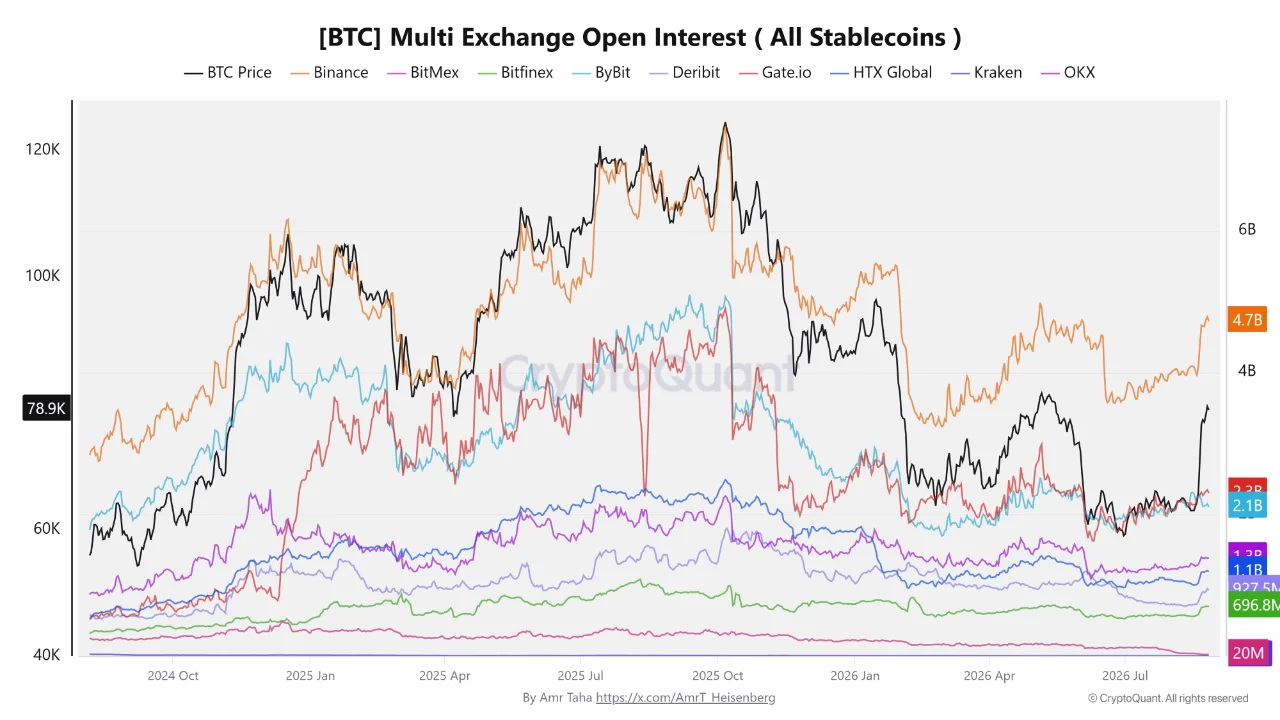
The derivatives metrics demonstrated that substantial leveraged participation remained active despite the market pullback. CryptoQuant also tracked roughly $325 million in Bitcoin liquidations throughout that timeframe.
Open interest monitors active derivatives contracts across exchanges. Because it accounts for both long and short positions, high totals do not dictate a specific market direction by themselves.
The provided derivatives dataset showed that Binance stablecoin-margined Bitcoin open interest hit $4.78 billion on August 25, climbing past its prior May 14 high of $4.74 billion.
In contrast, the same set of figures indicated that Gate, Bybit, and HTX remained beneath their respective May peaks. This divergence implied that leverage accumulation concentrated more heavily on Binance.
Such concentration amplified Binance’s sway over short-term derivatives metrics. Still, growth in open interest alone cannot confirm bullish or bearish sentiment.
Bitcoin Price Prediction Faces Counterweight From ETF Inflows
Figures from SoSoValue highlighted by Wu blocks.">Blockchain pointed to $314 million in net Bitcoin ETF inflows on August 25, extending the positive streak to seven consecutive days.

This ETF inflow data challenged the assumption that the recent price rejection stemmed strictly from weak demand. Healthy fund flows can happen simultaneously with declining spot prices.
Derivatives selling, profit-taking, or short-term positioning can counterbalance institutional purchases. This push-and-pull makes confirmation past resistance far more significant than a solitary rejection.
BlackRock’s iShares Bitcoin Trust stayed at the center of institutional investment channels for Bitcoin. The BlackRock prospectus detailed both cash and in-kind creation and redemption processes.
The filing named Jane Street Capital, Virtu Americas, JPMorgan Securities, and Marex Capital Markets as participants for in-kind transactions. These operations take place through authorized participants instead of direct retail trades.
That distinction is vital for claims suggesting holders can freely swap Bitcoin for IBIT shares without tax consequences. The BlackRock prospectus did not support such a broad interpretation.
Instead, the regulatory filing outlined fund creation and redemption mechanics rather than universal tax rules for Bitcoin owners. Tax implications rely on individual transaction structures and investor circumstances.
Consequently, the Bitcoin price prediction balanced conflicting market forces. Technical rejections signaled downward pressure, whereas ETF flows showed continued institutional interest.
Furthermore, Bitcoin maintained a strong distance above its early-August levels, with CoinMarketCap tracking the asset near $64,905 on August 8.
This advance left traders weighing ongoing consolidation against deeper distribution risks, keeping the $80,000 to $83,000 threshold as the primary technical obstacle.
A validated breakthrough above $83,000 would undermine Patel’s bearish outlook. Conversely, a failure at that point would direct focus back toward lower support and liquidity zones.
Elevated open interest could magnify liquidations if BTC experiences swift moves through leveraged setups. Meanwhile, ETF inflows remain a critical metric for tracking ongoing demand.
Bitcoin’s immediate verifiable technical test remains the $83,000 resistance threshold, while market participants keep a close watch on August 26 ETF flows and updated derivatives positioning.
This article is for informational purposes only and does not constitute financial advice. Cryptocurrency markets can experience sharp price movements.
FAQ
Why did the Bitcoin price prediction weaken?
The outlook weakened after BTC failed to hold above $81,000 and dropped back below $80,000 following a rejection at the $81,300 resistance area.
What are analysts saying about Bitcoin’s resistance?
Crypto Patel noted an inverted hammer pattern near $81,300, identifying $83,000 as the invalidation level and warning of a possible drop to $50,000–$55,000 if resistance holds.
Are Bitcoin ETFs still seeing inflows?
Yes, spot Bitcoin ETF inflows extended to seven consecutive trading sessions, including $314 million on August 25.
What is the current state of Bitcoin futures?
Bitcoin futures open interest remained elevated near $55.8 billion, accompanied by significant leveraged participation and ongoing liquidations.