


Key Insights:
- The Kalshi prediction market is planning to pursue U.S. approval for approximately 60 perpetual futures linked to popular stocks and exchange-traded funds, which include Apple, Tesla, and Nvidia.
- Citadel Securities is pushing back against this initiative, contending that equity-linked perpetuals ought to stay under SEC supervision while highlighting potential insider-trading and surveillance vulnerabilities driven by round-the-clock trading.
- Kalshi faces ongoing regulatory uncertainty, as the CME is actively contesting its bitcoin perpetual approval in federal court.
The Kalshi prediction market intends to apply for U.S. authorization regarding perpetual futures tied to prominent exchange-traded funds and equities. These proposed instruments would introduce round-the-clock, crypto-style derivatives trading to major equities like Apple, Tesla, and Nvidia.
According to The Wall Street Journal, Kalshi plans to ask the Commodity Futures Trading Commission for the green light on roughly 60 equity-based perpetual contracts.
While this expansion could broaden Kalshi’s footprint beyond cryptocurrency derivatives and prediction markets, Citadel Securities has objected to the filing while Wall Street continues to debate which regulatory body should govern these products.
Kalshi Prediction Market Eyes Single-Stock Perpetuals
Known primarily for event contracts, the Kalshi Prediction Market platform would become the first provider of regulated perpetual futures on single U.S. equities.
Chief Executive Officer Tarek Mansour and his team have dubbed these offerings “American Perpetuals,” which are built to grant U.S. traders access to crypto-style derivatives on a CFTC-regulated marketplace.
Based on reports from the WSJ, a spokesperson for Kalshi prediction markets stated that the platform has already secured CFTC approval for bitcoin perpetuals and anticipates similar clearances for stock perpetuals.
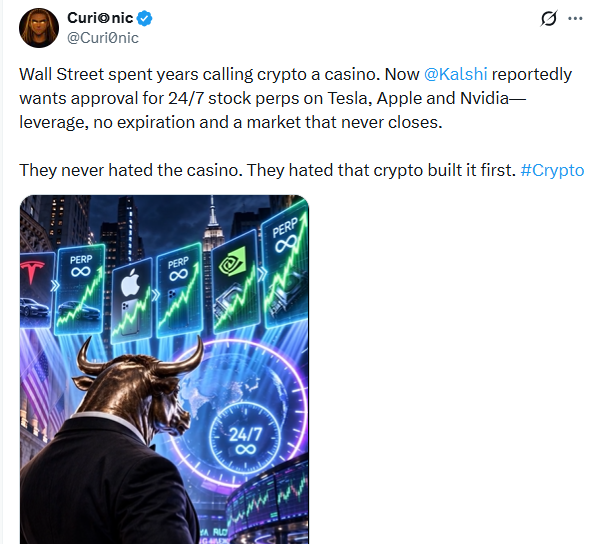
If approved, the new contracts would enable investors to place leveraged short or long bets on Nvidia, Apple, and Tesla stock 24/7 around the clock, rather than being restricted to traditional market hours.
Market watchers observe that this development combines mainstream equities with crypto derivative mechanisms, potentially capturing interest from both institutional and retail traders.
Regulatory and Legal Context
Kalshi’s latest push arrives during a period of evolving regulation. The Wall Street Journal points out that Kalshi will petition the CFTC for permission to list around 60 perpetual futures connected to stocks and ETFs, following the platform’s recent CFTC clearance for a regulated bitcoin perpetual in May 2026.
Certain Wall Street institutions have expressed apprehension: major trader Citadel submitted warnings to regulators, stating that equity-linked perpetuals operating outside SEC supervision might establish a “parallel market” carrying distinct safeguards.
Simultaneously, the Kalshi prediction market platform is entangled in legal disputes. New Jersey petitioned the U.S. Supreme Court in early September to decide whether state gambling statutes can govern Kalshi’s trading of sports-event prediction contracts.
This conflict—centering on whether Kalshi’s offerings fall under state or federal jurisdiction—highlights the broader friction surrounding innovative financial assets.
While the company asserts that federal law via the Commodity Exchange Act should supersede local gambling regulations, New Jersey maintains that Kalshi prediction markets must comply with state laws.
Crypto Derivatives and Tokenized Stocks
The stock-perpetual strategy mirrors Kalshi’s broader growth in the crypto derivatives sector. At the beginning of September 2026, Kalshi introduced perpetual futures for major digital assets like Binance Coin and Cardano under the “American Perpetuals” banner.
Rolled out on September 4, 2026, that launch featured dollar-settled contracts offering up to 4.5× leverage. The Coin Republic reports that Kalshi currently hosts over a dozen crypto perpetuals—including ETH as its native asset.">Ethereum, Bitcoin, and Dogecoin—on its regulated exchange.
Such offerings mirror a wider industry movement toward tokenized assets, exemplified by Payward’s Kraken (the power behind xStocks), which has likewise advocated for 24/7 tokenized stock trading across public blockchains.
The Coin Republic also mentioned that Kalshi “recently added Zcash, Near Protocol, Dogecoin, and Shiba Inu contracts”. The inclusion of Dogecoin among these new perpetuals emphasizes how even meme currencies are finding their way into regulated markets.
Additional cryptocurrency news outlets have highlighted that Dogecoin trading venues are broadening through tokenized and regulated platforms, giving investors fresh avenues to access the asset.
The debut of crypto perpetuals on the Kalshi prediction market aligned with notable price rallies, as ADA climbed nearly 10% and BNB advanced more than 5% upon their launch. Dogecoin has likewise experienced renewed retail attention as its availability expands across additional regulated financial instruments.
This article is for informational purposes only and does not constitute financial, investment, legal, or trading advice. Trading stocks, crypto assets, futures, and other derivatives involves risk. Readers should conduct their own research and consider their financial situation before making investment decisions.
FAQ
- What does the Kalshi prediction market plan to offer for stocks? Kalshi plans to seek U.S. approval for roughly 60 equity-linked perpetual futures tied to prominent names like Tesla, Apple, and Nvidia.
- Why is Citadel Securities opposing Kalshi’s stock perpetuals plan? Citadel argues that these products should remain under SEC oversight and warns that 24/7 trading could create surveillance and insider-trading gaps.
- What are “American Perpetuals”? They are crypto-style, CFTC-registered perpetual derivatives offered on Kalshi that give U.S. traders 24/7 leveraged access to various assets.
- Are there other legal challenges facing Kalshi? Yes, Kalshi is involved in legal battles regarding whether federal law preempts state gambling regulations, including a dispute involving New Jersey at the U.S. Supreme Court.


 Arnold Kirimi