主要洞察:
- XRP Ledger XLS-75 innovation improves permission delegation by closing security gaps found during V1.0 testing.
- XRP Ledger and Claude AI connect through formal verification work aimed at proving key ledger functions work as expected.
- The lending protocol will 支撑 institutional credit, including working capital and trade finance use cases.
Prominent XRP Ledger developer J. Ayo Akinyele has emphasized how the XLS-75 upgrade enhances the safety of permission delegation, following the discovery of a major security vulnerability prior to the feature’s deployment on the XRPL 主网. Version 1.1 preserves the core capability while incorporating necessary patches for multi-signing and delegate validation checks.
XRP Ledger Update: XLS-75 Gets A Safer Path To Mainnet
Akinyele clarified that Permission Delegation enables a designated account to execute actions on behalf of another, strictly bounded by the rules established by the primary account owner. This functionality assists users and 托管 entities in granting another account the ability to manage specific tasks without surrendering complete control.
Because delegation alters how the network processes transactions, security remained a primary focus. During testing of V1.0, a critical vulnerability was uncovered via the bug bounty program before the proposed amendment reached the main XRP Ledger network.
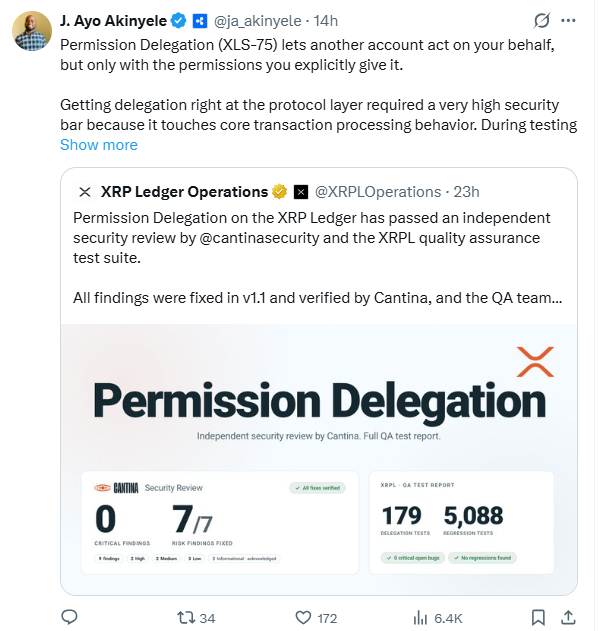
Rather than merely applying a patch to the existing code, the development team withdrew the amendment and presented V1.1. This establishes a distinct division between the initial build and the hardened release, establishing a more secure foundation for the XRP Ledger XLS-75 enhancement.
Version 1.1 resolves vulnerabilities concerning delegate identification and 区块 newer capabilities—such as Lending and Vault operations—from being improperly delegated. Furthermore, it corrects reserve accounting mechanisms associated with delegated transactions.
The update additionally eliminates a multi-signing route that could have bypassed delegation oversight. Revocation mechanics were reinforced, and the development group conducted broader evaluations of delegation alongside other network operations.
The primary objective of XLS-75 remains unaltered. The modification is designed to ensure the capability is secure to activate, which is vital since permission delegation grants secondary accounts operational authority, making precise constraints and oversight essential elements of the tool.
XRP Ledger And The Claude AI Verification Push
Broader development efforts on the XRP Ledger also encompass formal verification. XRPL contributor Mayukha Vadari noted that the team is collaborating with Common Prefix to mathematically validate critical components of the blockchain.
This initiative mirrors the formal methodologies recently applied alongside Claude AI to formalize Fermat’s Last Theorem. The objective is to mathematically guarantee that essential system components operate precisely as intended, moving beyond standard testing procedures.
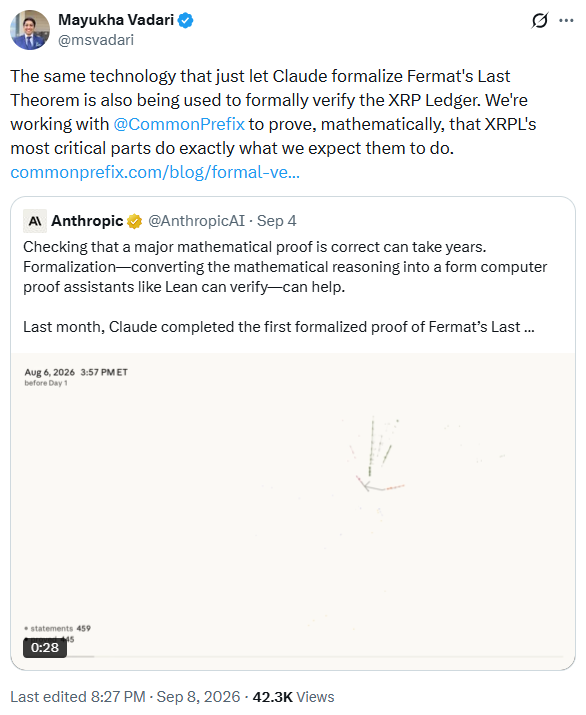
Consequently, the XRP Ledger and the correlation technology linked with Claude AI share a direct relationship built on formal verification. For a 去中心化 network managing accounts, financial transfers, and emerging monetary instruments, rigorous verification helps minimize the likelihood of unforeseen vulnerabilities.
This strategy also aligns with the choice to retract XLS-75 following the discovery of the V1.0 flaw. Both initiatives emphasize heightened scrutiny prior to launching significant architectural adjustments.
Insight Into The XRPL Lending Protocol
The XRP Ledger is concurrently preparing for native credit capabilities via XLS-66. Cicada Credit is slated to operate as the Loan Broker within the upcoming framework, directing its focus toward institutional-grade lending.
Cicada will manage off-chain responsibilities including borrower identification, risk assessment, credit evaluations, covenant formulation, and ongoing oversight. Concurrently, the protocol will execute on-chain operations such as loan 发行, interest accumulation, repayment tracking, and default handling.
This architecture diverges from numerous 去中心化金融 protocols that depend strictly on over-collateralized borrowing. Instead, the framework addresses practical corporate requirements, such as trade finance and working capital liquidity.
As an illustration, a stablecoin issuer awaiting an incoming traditional 法定 wire transfer could utilize the anticipated receivable as collateral, borrow RLUSD on the network, and settle the obligation once the 法定 wire settles.
The lending framework also integrates with Single Asset Vaults governed by XLS-65. These features form part of a broader initiative to introduce practical credit utility directly to the XRP Ledger.
Ultimately, the broader takeaway for the XRP Ledger is that incoming features undergo evaluation not only for functionality, but also for compatibility with foundational ledger protocols. This integration is crucial as institutional-grade applications join the network ahead of widespread deployment.
While market pricing for XRP remains independent of these network enhancements, the progress indicates that development surrounding the XRP Ledger extends well past basic payments. Security, formal verification, and credit protocols are advancing in tandem to elevate network utility while preserving its core architecture.
常见问题
- What is XRP Ledger XLS-75? XLS-75 is an innovation that improves permission delegation, allowing one account to act for another safely under strict limitations.
- Why was XRP Ledger V1.0 pulled? V1.0 was pulled after a critical security vulnerability was discovered during testing via the bug bounty program.
- What is the role of Claude AI in XRPL? Claude AI connects to the ledger through formal verification work, using mathematical methods to prove key functions work properly.
- How does the XRPL lending protocol work? It uses XLS-66 to 支撑 institutional credit, handling on-chain terms while off-chain brokers manage risk and borrower sourcing.